Engineering and Science Admissions Test

ESAT Preparation

ESAT Question Bank

Practice the way the ESAT actually tests you — topic-by-topic questions, full mock papers, and worked solutions for Maths 1, Maths 2, Physics, Chemistry and Biology. Built by Oxbridge and Imperial graduates.

5
ESAT modules covered
Timed
Full mock papers
100%
Worked solutions

What's Inside

Everything you need to prepare for the ESAT

Every ESAT module

Maths 1, Maths 2, Physics, Chemistry and Biology — matched to the modules your course requires.

Real exam style

27-MCQ, 40-minute module format with the no-calculator, time-pressured style the ESAT uses.

Worked solutions

Every question has a full, method-led solution — not just the answer key.

Timed mock papers

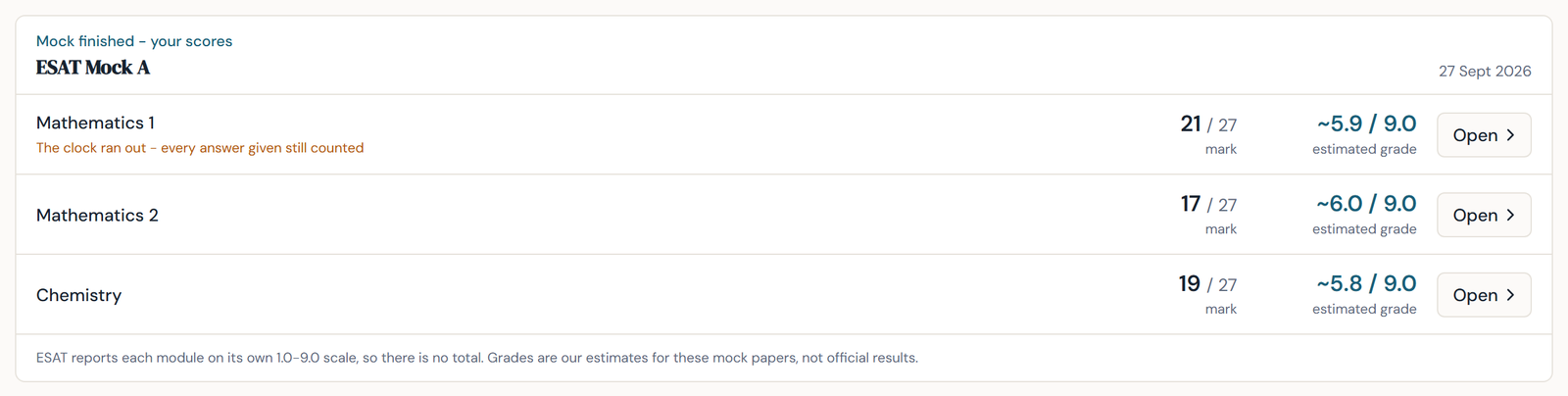
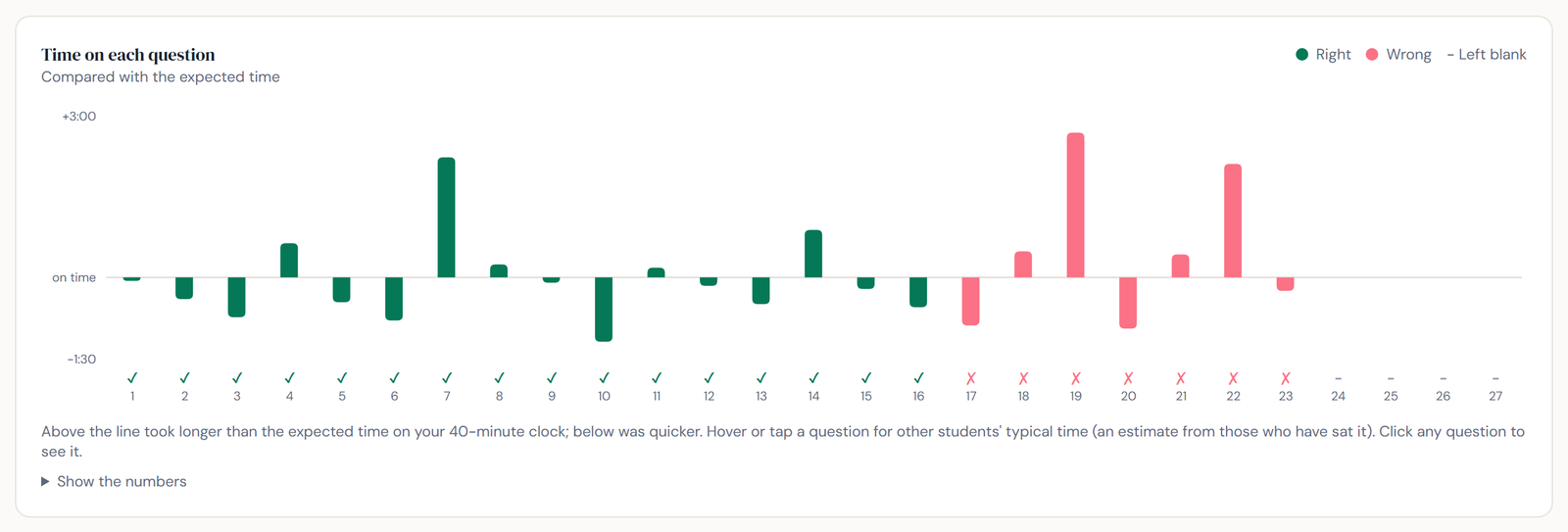
Sit full modules under exam conditions and see where your time goes.

Difficulty grading

Questions tiered from entry to stretch so you can ramp up to exam-day standard.

Built by specialists

Written and checked by Oxbridge and Imperial graduates who sat these tests.

The Numbers

ESAT facts, cited

5
Modules available to choose from
UAT-UK, 2025
27
Questions per module
UAT-UK, 2025
40 min
Time per module
UAT-UK, 2025
120 min
Total test time for most candidates
UAT-UK, 2025
1.0–9.0
Reported score scale per module
UAT-UK, 2025
None
Marks lost for a wrong answer
UAT-UK, 2025

Sources: UAT-UK (the body that delivers the ESAT) plus Cambridge, Imperial, UCL and Oxford admissions guidance, cross-checked in May 2026. Full 2027-entry dates and details are released by UAT-UK from April 2026.

Module Breakdown

The five ESAT modules, explained

Everyone sits Mathematics 1; you then take two further modules chosen for your course. Each module is 40 minutes, 27 multiple-choice questions, and no calculator is allowed.

Mathematics 1

Compulsory for every candidate. Tests fast, accurate handling of core pure maths.

  • Algebra and manipulation
  • Graphs and coordinate geometry
  • Sequences and series
  • Trigonometry
  • Probability and statistics

Sat by every ESAT candidate, whatever the course.

Mathematics 2

A further-maths-flavoured module, required by Cambridge Engineering and Oxford Physics-family courses.

  • Advanced algebra
  • Differentiation and integration
  • Logarithms and exponentials
  • Mechanics-style reasoning

Physics

Mechanics, electricity, waves and energy, with fast unit and dimensional work at its core.

  • Mechanics and motion
  • Electric circuits
  • Waves and light
  • Energy and work

Chemistry

Physical, inorganic and organic chemistry, leaning on moles, bonding and reaction reasoning.

  • Moles and quantitative chemistry
  • Atomic structure and bonding
  • Energetics
  • Organic reaction reasoning

Biology

Cells, biochemistry, genetics, physiology and ecology, testing quick recall and clean application.

  • Cell biology
  • Biochemistry
  • Genetics
  • Physiology and ecology

Difficulty Grading

How we grade difficulty

Every question is banded so you can ramp up deliberately: lock in method at Foundation, calibrate to exam standard at Standard, then separate yourself at Stretch.

Foundation

Consolidates core methods so technique and unit-handling become fast and automatic.

Standard

Pitched at genuine exam difficulty and pace, where you build reliable scoring.

Stretch

Harder items for top-end separation, with traps and multi-step reasoning.

Sample Questions

See how the ESAT actually tests you

A sample question from each module. Press "Show worked solution" to see the full method, not just the answer. Try them as you would on the day: no calculator, against the clock.

Mathematics 1

Pure maths everyone sits: algebra, graphs, sequences, trigonometry and probability, all without a calculator.

Sample questionMathematics 1
Foundation

The line L passes through the points (1, 4) and (3, 10). What is the equation of L?

  • y = 2x + 2
  • y = 3x + 1
  • y = 3x − 1
  • y = 2x + 1
  • y = 6x − 2
Show worked solution

Answer: B · y = 3x + 1

Gradient = (10 − 4) / (3 − 1) = 6 / 2 = 3.

Using y − 4 = 3(x − 1) gives y = 3x + 1. Check the second point: 3(3) + 1 = 10. ✓

Sample questionMathematics 1
Standard

The quadratic x2 + kx + 9 = 0 has exactly one (repeated) real root. What are the possible values of k?

  • k = 3 only
  • k = 6 only
  • k = ±3
  • k = ±6
  • k = ±9
Show worked solution

Answer: D · k = ±6

A repeated root means the discriminant b2 − 4ac = 0.

Here a = 1, b = k, c = 9, so k2 − 4(1)(9) = 0, giving k2 = 36.

Therefore k = ±6. The trap is to keep only the positive root.

Sample questionMathematics 1
Stretch

A fair six-sided die is rolled twice. What is the probability that the sum of the two rolls is a prime number?

  • 5 / 12
  • 1 / 3
  • 15 / 36
  • 1 / 2
  • 13 / 36
Show worked solution

Answer: C · 15 / 36

Possible sums run from 2 to 12. The prime sums are 2, 3, 5, 7 and 11.

Count the ordered outcomes for each: 2 → 1 way, 3 → 2, 5 → 4, 7 → 6, 11 → 2. Total favourable = 1 + 2 + 4 + 6 + 2 = 15.

Probability = 15 / 36 (which is also 5 / 12, but option C is written in the unsimplified form the question matches).

Mathematics 2

Further-maths-flavoured module: more advanced algebra, calculus, logarithms and mechanics-style reasoning.

Sample questionMathematics 2
Standard

Given that log2 x + log2 (x − 2) = 3, what is the value of x?

  • x = 2
  • x = 4
  • x = 6
  • x = 8
  • x = −2 or 4
Show worked solution

Answer: B · x = 4

Combine the logs: log2 [x(x − 2)] = 3, so x(x − 2) = 23 = 8.

Then x2 − 2x − 8 = 0, which factorises as (x − 4)(x + 2) = 0.

x = 4 or x = −2. Reject x = −2 because log of a negative number is undefined. So x = 4.

Sample questionMathematics 2
Stretch

The curve y = x3 − 6x2 + 9x has a local maximum at x = a and a local minimum at x = b. What is the value of a + b?

  • 2
  • 3
  • 4
  • 5
  • 6
Show worked solution

Answer: C · 4

Differentiate: dy/dx = 3x2 − 12x + 9 = 3(x2 − 4x + 3) = 3(x − 1)(x − 3).

Stationary points at x = 1 and x = 3. The cubic rises, falls, then rises, so the maximum is at x = 1 (a = 1) and the minimum at x = 3 (b = 3).

a + b = 1 + 3 = 4. You do not even need to test which is which, since the question only asks for the sum.

Physics

Mechanics, electricity, waves and energy, with an emphasis on fast unit work and dimensional reasoning.

Sample questionPhysics
Foundation

A ball is dropped from rest and falls freely for 2 seconds. Taking g = 10 m s−2 and ignoring air resistance, how far does it fall?

  • 10 m
  • 20 m
  • 40 m
  • 5 m
  • 80 m
Show worked solution

Answer: B · 20 m

Use s = ut + ½at2 with u = 0, a = 10 m s−2, t = 2 s.

s = 0 + ½ × 10 × 22 = ½ × 10 × 4 = 20 m.

The common error is forgetting the factor of ½ and writing 40 m (option C).

Sample questionPhysics
Standard

Two resistors, 3 Ω and 6 Ω, are connected in parallel. What is the combined resistance of the pair?

  • 9 Ω
  • 4.5 Ω
  • 2 Ω
  • 0.5 Ω
  • 18 Ω
Show worked solution

Answer: C · 2 Ω

For parallel resistors, 1/R = 1/3 + 1/6 = 2/6 + 1/6 = 3/6 = 1/2.

So R = 2 Ω. A useful check: the combined value of parallel resistors is always smaller than the smallest individual resistor, here 3 Ω.

Sample questionPhysics
Stretch

A 0.5 kg trolley moving at 4 m s−1 collides with a stationary 1.5 kg trolley and they move off together. What is their common velocity immediately after the collision?

  • 1 m s−1
  • 1.5 m s−1
  • 2 m s−1
  • 3 m s−1
  • 4 m s−1
Show worked solution

Answer: A · 1 m s−1

Conserve momentum: total before = total after.

Before: 0.5 × 4 + 1.5 × 0 = 2 kg m s−1.

After: combined mass = 0.5 + 1.5 = 2 kg, moving at v, so 2v = 2, giving v = 1 m s−1.

Chemistry

Physical, inorganic and organic chemistry: moles, bonding, energetics and reaction reasoning at speed.

Sample questionChemistry
Foundation

How many moles of oxygen molecules (O2) are present in 64 g of oxygen gas? (Relative atomic mass of O = 16.)

  • 1 mol
  • 2 mol
  • 4 mol
  • 0.5 mol
  • 32 mol
Show worked solution

Answer: B · 2 mol

Molar mass of O2 = 2 × 16 = 32 g mol−1.

Moles = mass / molar mass = 64 / 32 = 2 mol.

The trap is using the atomic mass 16 (giving 4 mol) instead of the molecular mass 32.

Sample questionChemistry
Standard

Which of the following best explains why the boiling point of water is much higher than that of hydrogen sulfide (H2S), despite both being group-16 hydrides?

  • Water has stronger covalent O–H bonds
  • Water molecules hydrogen-bond to one another
  • Water has a larger relative molecular mass
  • Oxygen is more metallic than sulfur
  • Water is a smaller molecule with weaker forces
Show worked solution

Answer: B · Water molecules hydrogen-bond to one another

Boiling point depends on the strength of intermolecular forces, not the strength of the covalent bonds inside the molecule.

Oxygen is highly electronegative and small, so O–H bonds allow strong hydrogen bonding between water molecules. H2S cannot hydrogen-bond effectively, so it boils far lower despite having a higher molecular mass.

Biology

Cells, biochemistry, genetics, physiology and ecology, testing quick recall and clean application.

Sample questionBiology
Foundation

Which of the following structures is found in a typical plant cell but NOT in a typical animal cell?

  • Mitochondrion
  • Ribosome
  • Cell-surface membrane
  • Cellulose cell wall
  • Nucleus
Show worked solution

Answer: D · Cellulose cell wall

Mitochondria, ribosomes, the cell-surface membrane and the nucleus are common to both plant and animal cells.

A cellulose cell wall is a feature of plant cells (and absent from animal cells), which is the distinguishing structure here.

Sample questionBiology
Standard

In humans, a man with blood group AB and a woman with blood group O have children. Which blood groups are possible in their offspring?

  • A or B only
  • AB or O only
  • A, B, AB or O
  • O only
  • AB only
Show worked solution

Answer: A · A or B only

The father (AB) passes on either IA or IB. The mother (O) is genotype ii, so she always passes on i.

Offspring genotypes are therefore IAi (group A) or IBi (group B).

So children can be group A or group B only. AB and O are not possible.

These are our own original practice questions, written to illustrate the ESAT style. They are not reproductions of real past-paper or copyrighted exam questions.

Your Prep Plan

An ESAT preparation timeline

Build coverage first, move into timed module practice, then rehearse full sittings under exam conditions.

  1. 6 months out

    Pick modules, map the spec

    Choose your modules and check the specification against your school syllabus. Prioritise topic coverage before speed.

  2. 3 months out

    Start timed module practice

    Begin timed, module-by-module practice and log mistakes by type: knowledge gap, setup error, algebra slip or misread.

  3. 1 month out

    Full timed sittings

    Shift to full 120-minute runs under strict timing, rehearsing guessing discipline, pacing and recovery after hard patches.

  4. Final week

    Light review, check logistics

    Review formulas, common traps and your error log rather than cramming. Confirm ID, travel and your booked modules.

Choose Your Package

Three ways to prepare

Start with self-paced practice, add full mocks and walkthroughs, or work 1-to-1 with an Oxbridge tutor.

Question Bank

£49

one-off payment

Self-paced practice with full worked solutions.

  • Full topic-by-topic question bank
  • Step-by-step worked solutions
  • Difficulty-graded questions
  • Access on any device
Get the Question Bank
Most popular

Complete Prep

£69

one-off payment

Everything in the bank, plus timed mocks and video walkthroughs.

  • Everything in Question Bank
  • Full timed mock papers
  • Video walkthroughs of hard questions
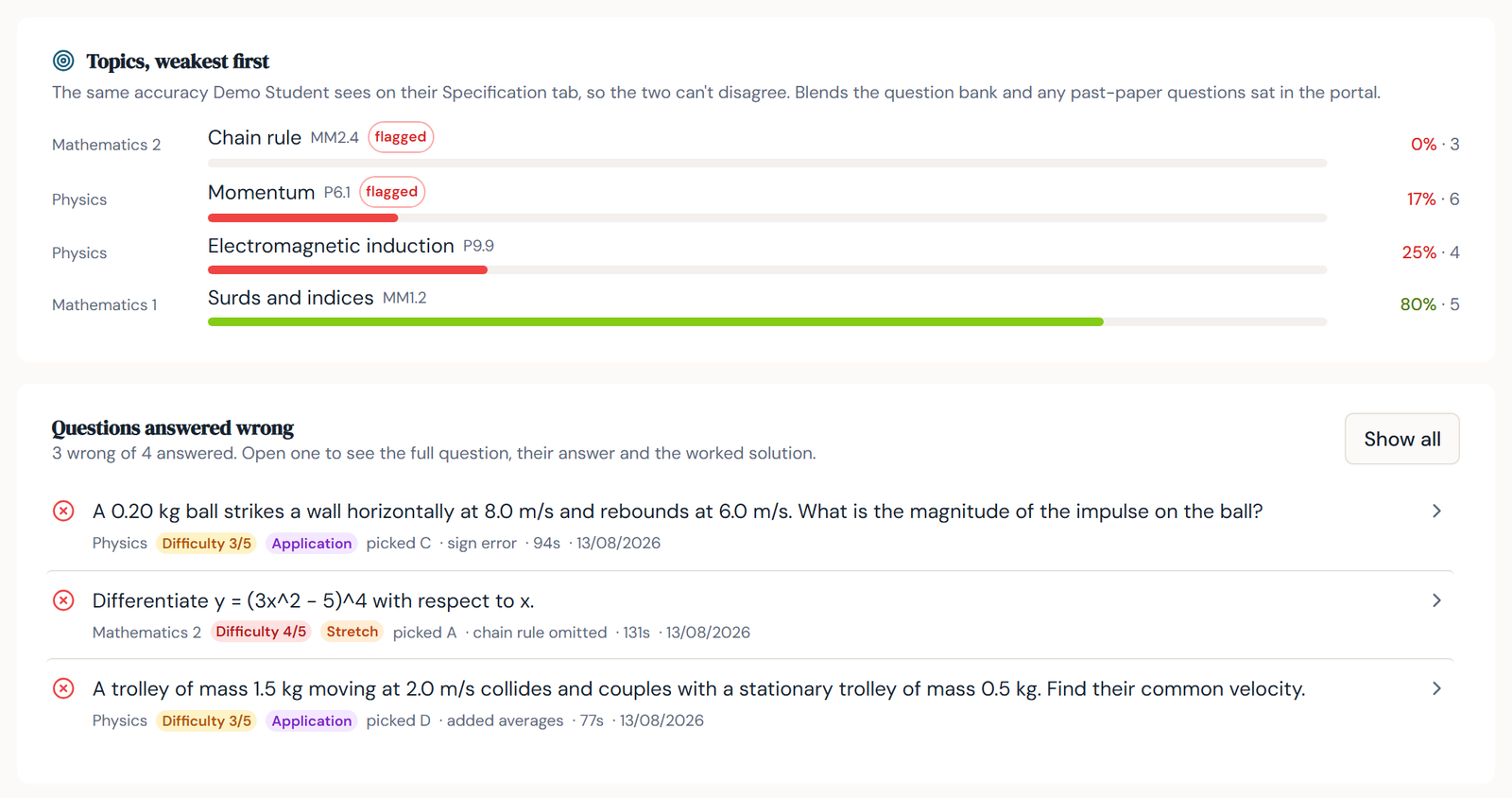
  • Performance tracking by topic
  • Exam-day strategy guide
Get Complete Prep

Tutored

£130

from / hour, incl. tutoring

Complete Prep plus 1-to-1 sessions with an Oxbridge tutor.

  • Everything in Complete Prep
  • 1-to-1 sessions with an Oxbridge tutor
  • Personalised study plan
  • Marked practice with written feedback
Talk to Us

Prices in GBP. Get in touch and we'll confirm access and answer any questions — no obligation.

ESAT Question Bank — FAQs

The Engineering and Science Admissions Test (ESAT) is required for Engineering, Physics, Natural Sciences, Biomedical Sciences and related courses at Oxford, Cambridge and Imperial for 2027 entry. You sit Mathematics 1 plus two further modules chosen for your course.
All five: Mathematics 1, Mathematics 2, Physics, Chemistry and Biology. You can focus on just the modules your course requires.
Yes — every question comes with a full, method-led worked solution, not just a final answer, so you learn the technique the ESAT rewards.
Yes. The Tutored package pairs the full question bank and mocks with 1-to-1 sessions with an Oxbridge or Imperial graduate tutor. Tell us your target course and we will match you.
Get in touch via the buttons above and we will set you up with access and confirm the details for your chosen package.

Not sure which ESAT package is right?

Book a free 30-minute consultation and we'll recommend the right level of support for your target course.

Book a Free Consultation