


Year
01 / 04
1
Year 1
Common Engineering Science foundation leading to first-year prelims.

Complete Admissions Guide
Engineering at Oxford is among the most selective courses in the UK. Get 1-to-1 admissions coaching from Oxford or Cambridge graduates with subject-specific admissions expertise.
Last updated: September 2026
Key Facts
Overview
Engineering Science at Oxford is a four-year MEng with UCAS code H100 and a typical A-Level offer of A*A*A. The course starts broad: the first two years are common, specialisation comes later, and applicants for 2027 entry must take ESAT Mathematics 1, Mathematics 2 and Physics.
Why study Engineering at Oxford?
Engineering Science is Oxford’s official undergraduate course title, and the degree is a four-year MEng. Oxford’s undergraduate route is deliberately broad rather than a set of separate specialist engineering degrees.

Section 01
Click your country on the map below for country-specific entry guidance - accepted qualifications, expected scores, English-language requirements, and any local context worth knowing before you apply.
International Applicants
Pick a highlighted country to see the admissions-test, score, and English-language requirements that apply for applicants from that country.
Section 02
| Qualification | Typical Offer | Key Requirements |
|---|---|---|
| A-Level | A*A*A with A* in Mathematics and Physics | Mathematics, Physics required. Further Mathematics recommended. |
| IB Diploma | 40 with 776 at HL | HL: Mathematics, Physics required. |
Section 03
May 2026
UCAS opens
Applications open in May; applicants can start preparing the UCAS form.
1 June 2026
ESAT registration opens
UAT-UK account creation, access-arrangement requests and bursary requests open at 3pm UK time.
20 July–28 September 2026
ESAT booking window
Book the ESAT test appointment before the 28 September 2026, 6pm UK time deadline.
12–16 October 2026
ESAT test window
Oxford applicants normally sit ESAT in this October window; China, Hong Kong and Macau use 12–13 October.
15 October 2026
Submit UCAS by 6pm UK time
Engineering Science has no verified supplementary form deadline.
16 November 2026
ESAT results released
Results for the October 2026 sitting are released on this date.
Early to mid-December 2026
Online interviews
Shortlisted applicants are expected to have two problem-based interviews.
12 January 2027
Oxford decisions released
Oxford releases undergraduate decisions for this cycle.
12 August 2027
A-Level / Level 3 results day
Provisional result date carried at partial confidence; recheck nearer the cycle.
May 2026
UCAS opens
Applications open in May; applicants can start preparing the UCAS form.
1 June 2026
ESAT registration opens
UAT-UK account creation, access-arrangement requests and bursary requests open at 3pm UK time.
20 July–28 September 2026
ESAT booking window
Book the ESAT test appointment before the 28 September 2026, 6pm UK time deadline.
12–16 October 2026
ESAT test window
Oxford applicants normally sit ESAT in this October window; China, Hong Kong and Macau use 12–13 October.
15 October 2026
Submit UCAS by 6pm UK time
Engineering Science has no verified supplementary form deadline.
16 November 2026
ESAT results released
Results for the October 2026 sitting are released on this date.
Early to mid-December 2026
Online interviews
Shortlisted applicants are expected to have two problem-based interviews.
12 January 2027
Oxford decisions released
Oxford releases undergraduate decisions for this cycle.
12 August 2027
A-Level / Level 3 results day
Provisional result date carried at partial confidence; recheck nearer the cycle.
Section 04

Engineering Science requires the Engineering and Science Admissions Test, or ESAT, for 2027 entry. The required ESAT modules are Mathematics 1, Mathematics 2 and Physics.
The test provider is UAT-UK, and delivery is through Pearson or Pearson VUE test centres. Registration opens on 1 June 2026 at 3pm UK time and closes on 28 September 2026 at 6pm UK time.
Oxford applicants normally use the October sitting, with the verified window recorded as 12–16 October 2026. Results for the October 2026 sitting are released on 16 November 2026.
For 2027 entry, Oxford Engineering Science uses ESAT, and applicants must take Mathematics 1, Mathematics 2 and Physics in the October 2026 sitting.
There is no pass/fail ESAT score or published fixed weighting for Engineering Science. For international applicants, this makes the test especially useful as a common academic comparison across qualifications; build the test-centre booking and revision calendar into the application plan early.
Full ESAT preparation and tutoring | format, scoring, strategy, and free practice resources.
ESAT Preparation & Tutoring →Section 05
Interview Invitation
Late Nov
Arrival to Interview
Early Dec
Technical Question
Mid Dec
Decision
Early Jan
Interview Invitation
Late Nov
Arrival to Interview
Early Dec
Technical Question
Mid Dec
Decision
Early Jan
Question Types You’ll See
The Engineering Science interview is a problem-based academic discussion. The style is maths and physics problem-solving, with engineering contexts used to test how you move from a physical situation to a mathematical model.
In practice, strong preparation is not memorising set answers. It is practicing how to set up a problem, explain assumptions and correct your route when a tutor points you elsewhere.
Mock interviews are useful when they build clarity under pressure rather than rehearsed scripts.
Practice real Oxford Engineering interview questions from our free question bank.
Engineering Interview Questions →
Section 06
Oxford does not publish formal numerical weighting for Engineering Science decisions.
That means a strong application has to be consistent: the school record, test performance and interview discussion should all point to the same mathematical and physical fluency.
Avoid a single-metric strategy.
Our recommendation · weighting of admission factors
Oxbridge Mentors recommendation, drawn from observed offer patterns. University of Oxford does not publish official weightings - exact balance varies by college, course and year.
Section 07

For Engineering Science, the personal statement should show how you think about engineered systems. A useful paragraph does not just say that you like bridges, aircraft, robotics or energy; it explains the physical principle that caught your attention and what you did next.
Choose two or three examples and analyse them properly. A small project with measured results is often stronger than a long list of books, courses and competitions with no reflection.
Make the statement fit Oxford’s broad Engineering Science route: connect your examples to modelling, mathematics, physics or the process of moving from a physical situation to a mathematical explanation. Avoid writing a generic “I have always loved problem solving” statement. Show the problem, the model, the constraint, the failed attempt, the calculation or the trade-off.
See a full annotated example with line-by-line expert commentary.
Engineering PS Example →Section 08
Treat them as useful preparation, not as a checklist.
A good Engineering Science project should make a physical idea measurable. Projects work best when you can define a variable, collect data, compare it with a prediction and explain the mismatch.
Project ideas can stay broad: build and test a small structure, model an energy system, or measure the performance of a sensor or motor. The important part is not the scale; it is whether you can explain the engineering judgement behind each decision.

Section 08
Use supercurricular work to build technical fluency by mixing calculation, physical intuition and communication.
These are support, not substitute. They help only if the core mathematics and physics are strong.
Keep a short engineering notebook for problems you tried and mistakes you corrected.:
Revisit mechanics and electricity questions after solving them, and ask what the result means physically.:
Read around one engineering problem rather than trying to cover every branch of engineering.:
Practice explaining diagrams, graphs and assumptions aloud.:
Choose activities that create evidence of thought, not just evidence of attendance.:
Section 08
Competitions are not required as official Oxford requirements. If you include one, make the value clear: what problem you worked on, what constraints mattered, and what you learned.
One or two competitions done well can say more than five half-attempted activities.
Coaching for these competitions
Section 09
Year
01 / 04
1
Common Engineering Science foundation leading to first-year prelims.

Year
02 / 04
2
Common Engineering Science work continues before later specialisation.

Year
03 / 04
3
Increasing specialisation and project work become more prominent.
Year
04 / 04
4
Final MEng year with further specialisation and project work.
Section 10
Build knowledge through three habits: solve harder mathematics and physics problems, read technical explanations slowly enough to reproduce the argument, and test ideas with small measurements. That preparation fits the admissions emphasis on modelling, physical reasoning and communicating mathematical ideas.
Strong subject preparation is active rather than decorative. After solving a problem, ask what the result means physically, what assumptions you made, and how the answer would change if one condition changed.
Use official admissions-test and course resources first, then add books, videos or competitions only when you can explain how they improved your engineering reasoning.
Structures: Or Why Things Don't Fall Down by J. E. Gordon explains the mechanics of materials, tension, compression and structural failure with clarity and wit. The New Science of Strong Materials By Gordon applies the same physical intuition to why materials behave as they do, directly useful for Oxford Engineering interview questions about stress, strain and design.
For video, Real Engineering And Practical Engineering Explain engineering principles through real infrastructure and failure case studies. Both channels practice the mode of physical reasoning that Oxford Engineering interviews test.
For problem practice, Isaac Physics Provides physics problems beyond A-level calibrated to admissions-test and first-year university difficulty. Mechanics: Motion, Forces, Energy and Gravity on Coursera (UNSW Sydney) consolidates the classical mechanics that underpins all engineering disciplines.

Section 11
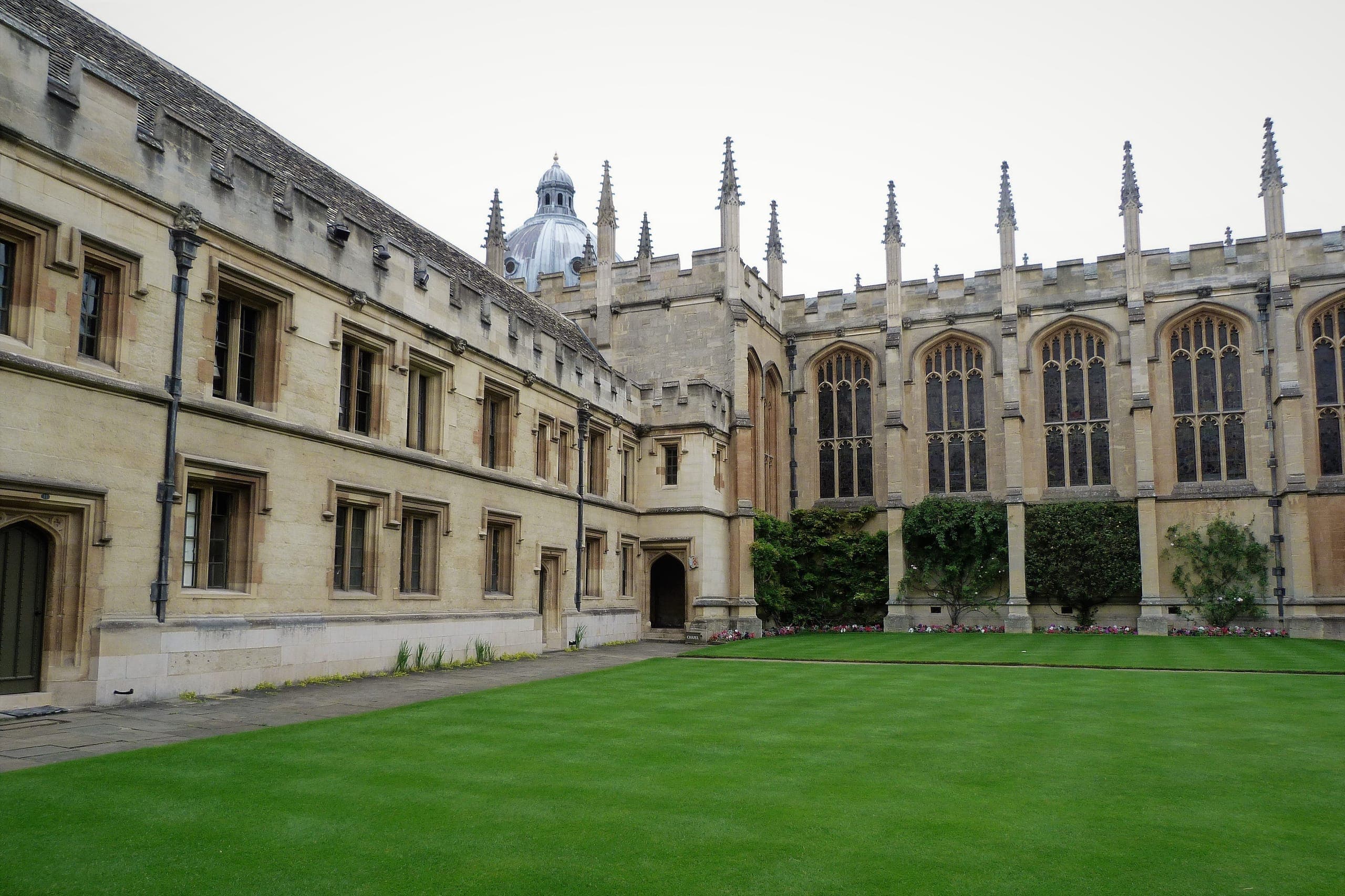
39 colleges offer this subject. ~20% of applicants submit an open application. ~33% of places come through the pool.
It also records reallocation: around 33% of successful applicants receive an offer from a college they did not specify, while Oxford’s 2024 dashboard summary gives 27.7% for that UCAS cycle.
This dataset does not verify that any particular college is strongest for Engineering Science. Choose a college for practical reasons, accommodation, location, size, environment, and treat reallocation as a normal part of the Oxford process.
Section 12
The verified careers data source is Discover Uni H100.
The main point is breadth.
Section 13
The contextual field is partial, but it confirms that this section should be framed as advice based on Oxford’s use of contextual information and Engineering Science subject requirements. It is not a separate quota or guarantee.
Context matters when it explains the conditions in which achievement happened. School subject availability, disruption, caring responsibilities, health issues or major educational interruption can all affect how an admissions tutor reads the file.
Further Mathematics is a useful example. Explain the context clearly, then make the strongest possible case through Mathematics, Physics, ESAT and interview preparation. For wider context, use Oxford’s official contextual-data guidance: https://www.ox.ac.uk/about/the-university/facts-and-figures/admissions-statistics/undergraduate.
Watch & Learn
Student vlogs, mock interviews, lecture tasters, and admissions advice.
All videos are the property of their respective creators.
Further Reading
Super-curricular reading, websites, and tools recommended by our expert tutors.