

Year
01 / 04
1
Core foundations
Equal grounding in mathematics and computer science
Balanced mathematics and computer science foundation.

Complete Admissions Guide
Mathematics and Computer Science at Oxford is among the most selective courses in the UK. Get 1-to-1 admissions coaching from Oxford or Cambridge graduates with subject-specific admissions expertise.
Last updated: September 2026
Key Facts
Overview
Mathematics and Computer Science at Oxford (UCAS GG14) is a joint degree combining proof-based mathematics with theoretical and practical computer science. For 2027 entry, the headline offer is A*A*A with TMUA required, and students can take either the 3-year BA route or the 4-year MMathCompSci route.
Why study Mathematics and Computer Science at Oxford?
Oxford ranks #1 in the available Guardian and Complete University Guide Computer Science ranking display used for this page, but the caveat matters: those rankings are for Computer Science / Computer Science and Information Systems, not specifically this joint course.
Section 01
Click your country on the map below for country-specific entry guidance - accepted qualifications, expected scores, English-language requirements, and any local context worth knowing before you apply.
International Applicants
Pick a highlighted country to see the admissions-test, score, and English-language requirements that apply for applicants from that country.
Section 02
| Qualification | Typical Offer | Key Requirements |
|---|---|---|
| A-Level | A*A*A with the A*s in Mathematics and Further Mathematics if available. | Mathematics required. Further Mathematics recommended. |
| IB Diploma | 39 points including core points, with 766 at Higher Level; the 7 must be in Higher Level Mathematics. | |
| Advanced Placement (AP) | For courses requiring A*A*A: either four APs at grade 5 (including any required subjects), or three APs at grade 5 (including any required subjects) plus ACT 33 or above or SAT 1480 or above. Applicants for courses requiring Mathematics should take AP Calculus BC if able; Calculus AB is accepted if Calculus BC is unavailable. AP Precalculus cannot fulfil the Mathematics requirement. |
Section 03
MAY to AUG 2026
Build UCAS application and test plan
UCAS applications open on 12 May 2026; completed applications can be submitted from 1 September.
1 JUN to 28 SEP 2026
Register and book TMUA
UAT-UK registration opens 1 June; booking runs 20 July to 28 September 2026.
1 SEP to 15 OCT 2026
Submit UCAS
Applications must reach UCAS by 6pm UK time on 15 October 2026 for Oxford.
12 to 16 OCT 2026
Sit TMUA
All Mathematics and Computer Science applicants must take both TMUA papers in the October sitting.
LATE NOV to EARLY DEC 2026
Receive shortlisting outcome
Interview invitations normally arrive between mid-November and early December.
EARLY to MID DEC 2026
Attend online interviews
Interviews are online, problem-based academic conversations.
12 JAN 2027
Receive Oxford decision
Shortlisted candidates receive the outcome via UCAS on 12 January 2027.
MAY to JUN 2027
Reply to UCAS offers
Reply deadlines include 5 May and 2 June depending on when all choices have responded.
AUG 2027
Meet offer conditions and confirmation
Conditional offers are confirmed after exam results; exact 2027 A-level results date not yet verified.
MAY to AUG 2026
Build UCAS application and test plan
UCAS applications open on 12 May 2026; completed applications can be submitted from 1 September.
1 JUN to 28 SEP 2026
Register and book TMUA
UAT-UK registration opens 1 June; booking runs 20 July to 28 September 2026.
1 SEP to 15 OCT 2026
Submit UCAS
Applications must reach UCAS by 6pm UK time on 15 October 2026 for Oxford.
12 to 16 OCT 2026
Sit TMUA
All Mathematics and Computer Science applicants must take both TMUA papers in the October sitting.
LATE NOV to EARLY DEC 2026
Receive shortlisting outcome
Interview invitations normally arrive between mid-November and early December.
EARLY to MID DEC 2026
Attend online interviews
Interviews are online, problem-based academic conversations.
12 JAN 2027
Receive Oxford decision
Shortlisted candidates receive the outcome via UCAS on 12 January 2027.
MAY to JUN 2027
Reply to UCAS offers
Reply deadlines include 5 May and 2 June depending on when all choices have responded.
AUG 2027
Meet offer conditions and confirmation
Conditional offers are confirmed after exam results; exact 2027 A-level results date not yet verified.
Section 04

Oxford requires the Test of Mathematics for University Admission (TMUA) for Mathematics and Computer Science in the 2027 entry cycle. TMUA is delivered by UAT-UK through Pearson professional test centres.
The required TMUA papers are Paper 1: Applications of Mathematical Knowledge and Paper 2: Mathematical Reasoning. The test window is 12–16 October 2026, with registration opening on 1 June 2026 at 3pm BST and closing on 28 September 2026 at 6pm BST.
This is a cycle change: from the 2027-entry cycle, with the test taken in October 2026, TMUA replaces MAT for this route. For applicants who have older advice saved, this is the detail to update first.
TMUA is a material part of shortlisting, and Oxford uses course selection criteria and the TMUA result to decide whom to invite for interview. UAT-UK indicates there is no pass/fail score, but Oxford does not publish a score threshold or fixed weighting.
For international applicants, TMUA gives Oxford another way to compare applicants taking different qualifications. Candidates testing in China, Hong Kong or Macau have a restricted 15–16 October window within the October sitting.
We recommend starting with the official TMUA specification, then moving into timed papers and error review. A useful next page is our TMUA guide.
Full TMUA preparation and tutoring | format, scoring, strategy, and free practice resources.
TMUA Preparation & Tutoring →Section 05
Interview Invitation
Late Nov
Arrival to Interview
Early Dec
Technical Question
Mid Dec
Decision
Early Jan
Interview Invitation
Late Nov
Arrival to Interview
Early Dec
Technical Question
Mid Dec
Decision
Early Jan
Question Types You’ll See
Oxford interviews for this course are online, problem-based academic discussions in the early to mid-December 2026 interview window. The interview style is a short tutorial / problem-solving format.
The interview tests strong mathematical ability, unfamiliar problem solving, ability to absorb new ideas, independent thinking, aptitude and technical skills, perseverance, enthusiasm and motivation. Typical question types include unseen proof or problem-solving tasks, algorithmic reasoning, logic or combinatorics, small-cases-to-generalisation problems and discussion after hints.
In practice, the best preparation is not memorising speeches. We recommend practicing how to say what you are trying, what has failed, what pattern you can see, and how you would test a conjecture. A strong answer can start messily and become clearer, especially if you slow down, state assumptions, and respond to hints as information rather than as criticism.
Practice real Oxford Mathematics and Computer Science interview questions from our free question bank.
Mathematics and Computer Science Interview Questions →
Section 06
The criteria shown are TMUA / admissions test performance, interview performance, prior attainment and predicted grades, personal statement and academic reference, and contextual or extenuating circumstances. Oxford also considers UCAS information and contextual information in the Computer Science-family process.
In reality, the decision is academic and comparative. We recommend preparing as if the test and interview are the two places where you most clearly demonstrate live mathematical and computational reasoning.
Our recommendation · weighting of admission factors
Oxbridge Mentors recommendation, drawn from observed offer patterns. University of Oxford does not publish official weightings - exact balance varies by college, course and year.
Section 07

For this course, the personal statement should show how your interest in mathematics and computer science connects. Avoid a list of technologies; Oxford’s course is built around proof, algorithms, models of computation and programming foundations.
A useful paragraph often starts with one problem, theorem, algorithm or project. Explain what you first thought, what changed your mind, and what you learned about reasoning.
We recommend using one mathematics example and one computing example, then adding one bridge between them. For example, an algorithmic puzzle can become interesting because of its proof of correctness, not just because the code runs.
Do not over-claim. It is better to explain a small project precisely than to describe artificial intelligence, cryptography or quantum computing in slogans.
Section 08
The verified project guidance suggests three broad project ideas: a proof-and-program portfolio, an algorithmic puzzle journal, and a mathematical modelling mini-project. Each works because it gives you something concrete to discuss in a problem-solving interview.
A good project does not need to be large. It should show that you can define a problem, try an approach, inspect mistakes, and connect the mathematical idea to the computational implementation.
Broad project ideas:

Section 08
Useful activities include proof practice, programming fluency, reading beyond the syllabus, admissions-test practice, discussion and explanation, and Oxford Maths/CS outreach.
These are support, not substitute. The core evidence still comes from how well you reason through mathematical and computational problems.
Practice full olympiad or university-style proof solutions.:
Implement algorithms and data structures, then explain time and space complexity.:
Keep notes on one mathematics text and one computer science text.:
Use timed TMUA-style problem solving and error review.:
Explain solutions aloud to peers or teachers.:
Use Oxford Maths/CS outreach talks and problem resources.:
Section 08
Competitions are not required. What they do well is stretch you beyond routine school exercises and give you harder problems to analyse.
None are required; one or two done well beats five half-attempted.
Coaching for these competitions
Section 09
Year
01 / 04
1
Equal grounding in mathematics and computer science
Balanced mathematics and computer science foundation.

Year
02 / 04
2
Core theory, options and group design practical
Compulsory work in both subjects plus optional papers and group practical.
Year
03 / 04
3
Breadth across mathematics and computer science
Option-led advanced mathematics and computer science.
Year
04 / 04
4
Advanced study and substantial independent work
Advanced options plus dissertation or project.
Section 10
Start with the Oxford Mathematics And Computer Science course page because it gives the official course identity, requirements and course outline. For the test, use UAT-UK TMUA information as the official test resource.
For subject-building, MIT Mathematics for Computer Science is a useful open-access archival course because it links proof, discrete mathematics and computational thinking. Project Euler Is useful if you treat each problem as a reasoning exercise, not a race to code.
For admissions context, the Oxford Department of Computer Science undergraduate admissions statistics help you understand the Computer Science-family process. International applicants should also keep the Oxford international qualifications Page close while checking qualification equivalence.
The British Informatics Olympiad Is worth using as algorithmic practice if you review why a solution works, not only whether it passes tests.

Section 11
30 colleges offer this subject. 22.2% of applicants submit an open application. 35.8% of places come through the pool.
Around a fifth of applicants make open applications; the 2023-24 Computer Science-family report recorded 22.2% open applications, but this is a CS-family figure rather than an MCS-only statistic. Around a third of successful applicants receive an offer from a college they did not specify; the same CS-family report recorded 35.8% offers by non-applied colleges, again with the CS-family caveat.
Oxford calls this process reallocation. It is used to even out competition, assign open applications to a college or hall with relatively fewer applications, and allow applicants to be interviewed by another college when a college is oversubscribed.
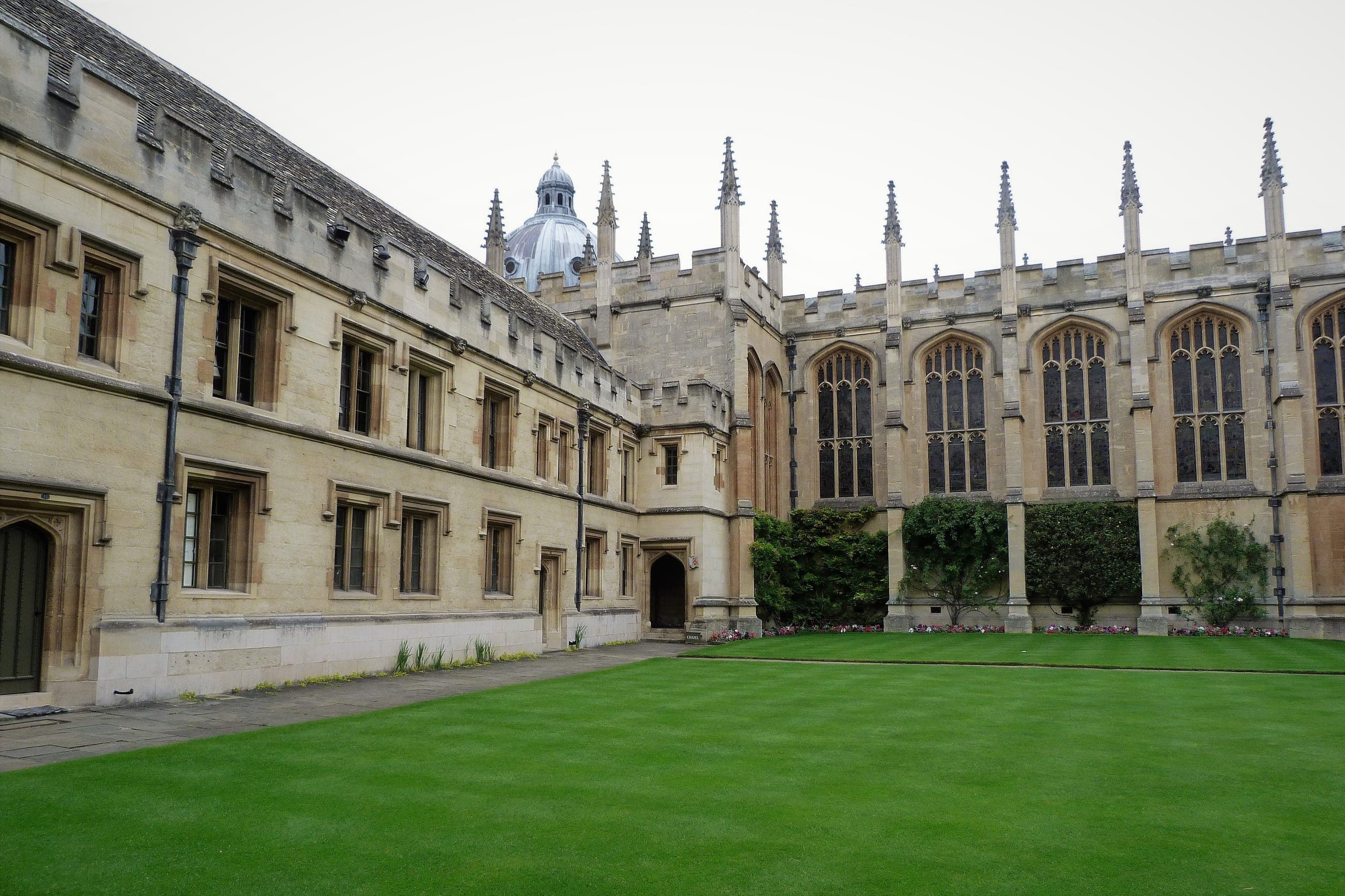
College choice affects tutorials, accommodation and social base, but it is not a tactical shortcut because colleges use a shared admissions framework. We recommend choosing a college you would be happy to live and study in, or making an open application if you do not have a strong preference.
Section 12
Discover Uni reports 85% work or study and 95% of employed respondents in highly skilled work, with Information Technology Professionals as the largest occupation category. Employer examples include IBM, Google, Amazon, Morgan Stanley and Goldman Sachs across technology, software, business, research and finance-related outcomes.
Treat the career chart carefully. The occupation outcomes are based on 20 employed respondents 15 months after the course, so they are not employer-sector market shares.
Section 13
Oxford considers academic achievement in context where possible. Contextual processes can support applicants from disadvantaged or disrupted backgrounds.
For this course, context can include whether Further Mathematics was available at school, because Oxford lists alternative routes where Further Mathematics is unavailable. Mitigating circumstances should be communicated early through UCAS, the reference or the relevant Oxford process.
We recommend making the context specific and evidenced. A clear sentence from a referee about subject availability or disruption is more useful than a vague explanation added late.
Watch & Learn
Student vlogs, mock interviews, lecture tasters, and admissions advice.
MIT OpenCourseWare lecture introducing proofs in Mathematics for Computer Science.
CS50x overview introducing Harvard’s computer science course and its problem-solving approach.
Oxford Mathematics public lecture on prime numbers with James Maynard and Hannah Fry.
Oxford Mathematics student lecture introducing networks as a language for modelling systems.
Computerphile explanation of Turing machines and the halting problem.
All videos are the property of their respective creators.
Further Reading
Super-curricular reading, websites, and tools recommended by our expert tutors.