
Year
01 / 03
1

Complete Admissions Guide
Philosophy and Theology at Oxford is among the most selective courses in the UK. Get 1-to-1 admissions coaching from Oxford or Cambridge graduates with subject-specific admissions expertise.
Last updated: September 2026
Key Facts
Overview
Philosophy and Theology at the University of Oxford is a 3-year BA with UCAS code VV56 and a typical AAA offer. It combines close argument with theological and religious study, requires one written-work submission, and has no admissions test for 2027 entry.
Why study Philosophy and Theology at Oxford?
Philosophy and Theology at Oxford is distinctive because it asks you to handle abstract argument and religious interpretation together, rather than treating them as separate interests. The course suits applicants who want to test claims about knowledge, ethics, God, scripture and religious practice with careful definitions and evidence.
Section 01
Click your country on the map below for country-specific entry guidance - accepted qualifications, expected scores, English-language requirements, and any local context worth knowing before you apply.
International Applicants
Pick a highlighted country to see the admissions-test, score, and English-language requirements that apply for applicants from that country.
Section 02
| Qualification | Typical Offer | Key Requirements |
|---|---|---|
| A-Level | AAA | |
| IB Diploma | 39 (including core points) with 666 at HL | |
| Advanced Placement (AP) | Either four APs at grade 5 (including any subjects required for the course) or three APs at grade 5 plus ACT 31+ or SAT 1460+. |
Section 03
SEP to MAY (Yr 12)
Build academic fit and choose written work
Read in both philosophy and theology, practice clear argument, and identify a recent essay that could demonstrate structured reasoning.
MAY to SEP
Prepare UCAS application
For 2027 entry, applicants can start working on UCAS from May 2026 and submit completed applications from early September.
15 OCT
Submit UCAS
Submit the UCAS application by 6pm UK time on 15 October 2026.
10 NOV
Submit written work
Submit one piece of written work in English by 10 November 2026.
MID NOV to EARLY DEC
Watch for shortlisting email
Interview invitations are usually sent between mid-November and early December, with about a week’s notice possible.
8 to 11 DEC
Attend online interviews
Philosophy and Theology first and second college interviews are scheduled for Monday 8 to Thursday 11 December 2026.
12 JAN
Receive Oxford decision
Shortlisted candidates for 2027 entry are due to receive the outcome of their application via UCAS on 12 January 2027.
5 MAY
Reply to offers if this UCAS deadline applies
UCAS states that applicants who receive all decisions by 31 March 2027 must reply by 5 May 2027, except where Extra applies.
AUG
Meet offer conditions and confirm place
Conditional offer holders should check results and UCAS confirmation when qualification results are released. Exact 2027 results day remains unverified here.
SEP to MAY (Yr 12)
Build academic fit and choose written work
Read in both philosophy and theology, practice clear argument, and identify a recent essay that could demonstrate structured reasoning.
MAY to SEP
Prepare UCAS application
For 2027 entry, applicants can start working on UCAS from May 2026 and submit completed applications from early September.
15 OCT
Submit UCAS
Submit the UCAS application by 6pm UK time on 15 October 2026.
10 NOV
Submit written work
Submit one piece of written work in English by 10 November 2026.
MID NOV to EARLY DEC
Watch for shortlisting email
Interview invitations are usually sent between mid-November and early December, with about a week’s notice possible.
8 to 11 DEC
Attend online interviews
Philosophy and Theology first and second college interviews are scheduled for Monday 8 to Thursday 11 December 2026.
12 JAN
Receive Oxford decision
Shortlisted candidates for 2027 entry are due to receive the outcome of their application via UCAS on 12 January 2027.
5 MAY
Reply to offers if this UCAS deadline applies
UCAS states that applicants who receive all decisions by 31 March 2027 must reply by 5 May 2027, except where Extra applies.
AUG
Meet offer conditions and confirm place
Conditional offer holders should check results and UCAS confirmation when qualification results are released. Exact 2027 results day remains unverified here.
Section 04

Philosophy and Theology at University of Oxford does not require a written admissions test for 2027 entry. Applications are assessed on academic record, personal statement, submitted written work (where requested), and interview performance.
Always verify on the official Oxford admissions tests page.
Section 05
Interview Invitation
Late Nov
Arrival to Interview
Early Dec
Technical Question
Mid Dec
Decision
Early Jan
Interview Invitation
Late Nov
Arrival to Interview
Early Dec
Technical Question
Mid Dec
Decision
Early Jan
Question Types You’ll See
Oxford’s interview guidance describes interviews as academic conversations modelled on tutorial-style teaching. For Philosophy and Theology, discussion may use submitted written work, unfamiliar ideas, a religious, philosophical or ethical issue, or a brief text.
The interview is testing interest and motivation, critical and analytical approach, reasoned defence of a viewpoint, response to counterarguments, close reading and independent thinking. Current official sources verify online interviews, panel norm, December timing, course-specific dates and assessment style, but not exact duration.
We recommend practicing aloud with short texts and problems rather than memorising answers. A useful answer shows what you think, why you think it, what might weaken it and how you would revise it.
Practice real Oxford Philosophy and Theology interview questions from our free question bank.
Philosophy and Theology Interview Questions →
Section 06
The course does not use an admissions test, and no portfolio requirement is listed for Philosophy and Theology. That makes the written work and interview especially important as direct evidence of how you handle argument and interpretation.
In reality, decisions are not made from a single impressive sentence in the personal statement. Tutors are looking for a consistent academic pattern: good grades, serious reading, clear writing and the ability to think under pressure.
Our recommendation · weighting of admission factors
Oxbridge Mentors recommendation, drawn from observed offer patterns. University of Oxford does not publish official weightings - exact balance varies by college, course and year.
Section 07

Start with the problems that made you think harder. For this course, a strong paragraph might compare a philosophical argument with a theological interpretation, then explain where the tension lies.
Avoid writing a general statement about loving big questions. It is better to show one precise question, one text or lecture you used, one objection you considered and one way your view changed.
Because no required school subject is specified, the statement can help connect your academic route to the course. We recommend showing evidence of essay-based thinking, since Oxford notes that an essay-writing subject can be helpful even though it is not required.
Section 08
Supercurricular work is not an admissions requirement, but the suggested activities are retained as preparation guidance for this page. The best projects are small enough to finish and precise enough to discuss in an interview.
Project ideas include comparing two arguments for God’s existence, building a mini dossier on evil and suffering, and close-reading a primary religious text with a philosophical commentary.

Section 08
Good supercurricular work should leave a trace: a question, a summary, an objection, or a better definition. The suggested activities are useful because they produce material you can discuss.
These are support, not substitute. The real value is in how you think about them afterwards.
Keep an argument journal that tracks claims, premises, objections and revised positions.:
Read primary texts and summarise arguments in numbered premises before evaluating them.:
Practice 1,000-2,000 word essays with definitions, objections and conclusions.:
Attend lectures or public philosophy/theology events, then write the strongest argument and one tutorial question.:
Use a discussion group or debate to clarify concepts and improve arguments.:
Sample introductory material on biblical languages, ancient philosophy or religious history.:
Section 08
Competitions are not required; what they do well is stretch argument, structure and independent writing. One or two done well beats five half-attempted.
Coaching for these competitions
Section 09
Year
01 / 03
1

Year
02 / 03
2
Year
03 / 03
3
Section 10

One piece of written work in English is required for Philosophy and Theology. It should be from current or recent study, no more than 2,000 words, and does not need to be on Philosophy, Theology or Religion.
The deadline is 10 November 2026. There is a source conflict: Oxford’s summary table lists none, while the official course page explicitly requires one piece; this draft follows the course page and faculty guidance.
We recommend choosing work that shows argument rather than decoration. A plain, well-structured essay with definitions, evidence and objections is usually more useful than a dramatic topic handled loosely.
Section 11
For philosophy foundations, start with Bertrand Russell’s The Problems of Philosophy, which is described as a concise entry point into scepticism, knowledge and philosophical method. Edward Craig’s Philosophy: A Very Short Introduction gives a compact map of core philosophical questions.
For theology, David F. Ford’s Theology: A Very Short Introduction is retained as a balanced introduction, while Augustine’s Confessions connects philosophy and theology through a primary text. The point is not to collect book titles, but to practice moving from summary to argument.
For video and audio, Wireless Philosophy is useful for short animated explanations, The Royal Institute of Philosophy for public lectures and debates, and Closer To Truth for long-form interviews on mind, meaning and religion. Philosophy Bites, The Panpsycast Philosophy Podcast and In Our Time: Philosophy give different levels of discussion and can help you test whether you can explain an argument in your own words.
For structured courses, Coursera’s Philosophy, Science and Religion is directly relevant to philosophical argument, science and religion, Introduction to the Old Testament (Hebrew Bible) supports academic study of religious texts, Philosophy and the Science of Human Nature connects ethics, political philosophy and human nature, and MIT OpenCourseWare ’s Problems of Philosophy gives a university-level introduction.

Section 12
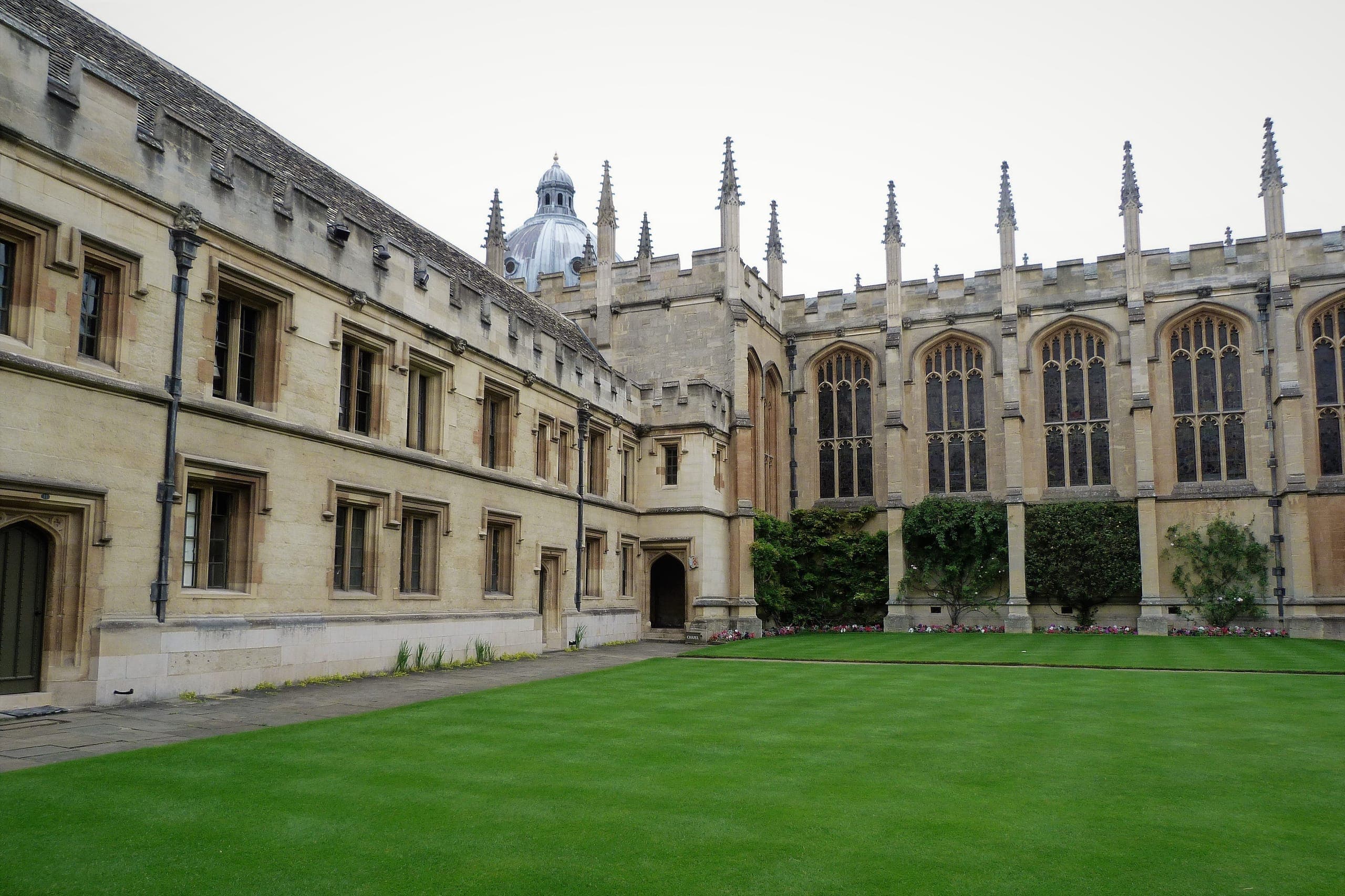
43 colleges offer this subject. ~20% of applicants submit an open application.
Oxford is collegiate, and the data used here counts 43 colleges including societies and permanent private halls. For Philosophy and Theology, the current central course-college list includes Christ Church, Harris Manchester College, Jesus College, Keble College, Lady Margaret Hall, Mansfield College, Oriel College, Pembroke College, Regent’s Park College, St John’s College, St Peter’s College, Worcester College and Wycliffe Hall.
Oxford uses reallocation to spread shortlisted candidates across colleges, and open applications are assigned to colleges with relatively fewer applications for the course that year. The college-choice data gives around a fifth of applicants making open applications and around a third of successful applicants receiving an offer from a college they did not specify.
College choice affects living and tutorial community, but should not be treated as a shortcut to admission because colleges follow a common admissions framework. We recommend choosing a college for practical reasons: accommodation, size, location and whether it offers the course.
Section 13
No official Philosophy and Theology-only sector split was located, so the careers data below uses Oxford Humanities-sector data as a labelled proxy. The course-page careers material and sector proxy should therefore be read as broad destination context, not as a promise that one degree leads to one career path.
The transferable skill is disciplined interpretation: reading carefully, separating claims from evidence, and writing a conclusion that follows from the argument. That can be useful in law, education, public policy, journalism, consulting, finance, charity work and further academic study, but the available data does not provide Philosophy and Theology-only percentages for those routes.
Section 14
Oxford uses contextual data to understand achievement in context, but it does not replace the academic standard. For UK applicants, contextual information may include school performance, individual performance against school averages, area indicators, Free School Meals since age 11, care experience and widening participation flags.
Applicants from the most disadvantaged backgrounds may be strongly recommended for shortlisting if evidence suggests they are likely to meet the offer and perform suitably in any required test; Philosophy and Theology has no admissions test for 2027 entry. GCSE or IGCSE grades are not required for this course, and where applicants have not taken GCSEs, teacher references and internal data can help provide context.
Watch & Learn
Student vlogs, mock interviews, lecture tasters, and admissions advice.
Official Oxford-style demonstration interview.
Introduces a central argument in philosophy of religion.
Starting point for analysing the problem of evil.
Open Yale Hebrew Bible lecture.
Connects philosophical texts with modern evidence.
All videos are the property of their respective creators.
Further Reading
Super-curricular reading, websites, and tools recommended by our expert tutors.