
Year
01 / 03
1
/ Terms 1-3
Four written Preliminary papers introduce the range of Theology and Religion.

Complete Admissions Guide
Theology and Religion at Oxford is among the most selective courses in the UK. Get 1-to-1 admissions coaching from Oxford or Cambridge graduates with subject-specific admissions expertise.
Last updated: September 2026
Key Facts
Overview
Theology and Religion at the University of Oxford is a 3-year BA with UCAS code V600 and an AAA typical A-level offer. For 2027 entry, there is no written admissions test; applicants submit one piece of written work and shortlisted candidates have online interviews.
Why study Theology and Religion at Oxford?
The 2024-25 admissions process recorded 109 Theology and Religion applicants, 60 shortlisted applicants and 30 offers.
Section 01
Click your country on the map below for country-specific entry guidance - accepted qualifications, expected scores, English-language requirements, and any local context worth knowing before you apply.
International Applicants
Pick a highlighted country to see the admissions-test, score, and English-language requirements that apply for applicants from that country.
Section 02
| Qualification | Typical Offer | Key Requirements |
|---|---|---|
| A-Level | AAA | |
| IB Diploma | 38 (including core points) with 666 at HL | |
| Advanced Placement (AP) | Either four APs at grade 5 (including any subjects required for the course) or three APs at grade 5 plus ACT 31+ or SAT 1460+. |
Section 03
May 2026
Applications open
Oxford's general guidance says applications open in May for applicants applying a year before course start.
October 2026
UCAS deadline
15 October 2026 (6pm UK time)
November 2026
Written work deadline
10 November 2026
December 2026
Interview window
8-11 December 2026
January 2027
Decisions released
12 January 2027
August 2027
A-level results day
12 August 2027
May 2026
Applications open
Oxford's general guidance says applications open in May for applicants applying a year before course start.
October 2026
UCAS deadline
15 October 2026 (6pm UK time)
November 2026
Written work deadline
10 November 2026
December 2026
Interview window
8-11 December 2026
January 2027
Decisions released
12 January 2027
August 2027
A-level results day
12 August 2027
Section 04

Theology and Religion at University of Oxford does not require a written admissions test for 2027 entry. Applications are assessed on academic record, personal statement, submitted written work (where requested), and interview performance.
Always verify on the official Oxford admissions tests page.
Section 05
Interview Invitation
Late Nov
Arrival to Interview
Early Dec
Technical Question
Mid Dec
Decision
Early Jan
Interview Invitation
Late Nov
Arrival to Interview
Early Dec
Technical Question
Mid Dec
Decision
Early Jan
Question Types You’ll See
Theology and Religion interviews are held online via Microsoft Teams. The typical panel size is two academics or interviewers.
The interview is not a performance of pre-learned theology. It is closer to a guided academic discussion: you may be asked to interpret an argument, respond to a passage, clarify a distinction or rethink an answer when challenged.
Prepare by practicing slow reading and clear explanation. For Theology and Religion, that might mean explaining how a textual detail, ethical claim or religious concept changes the argument you are making, rather than trying to deliver a memorised speech.
Practice with realistic questions from our free mock interview question bank.
Free Mock Questions →
Section 06
Oxford's official sources support a holistic and contextual assessment of the UCAS form, academic record, reference, written work and interview.
That matters because a strong application is not built around a single trick. Written work, interview discussion and school record all need to point in the same direction: careful reading, intellectual honesty and the ability to develop an argument.
Oxford uses contextual data to understand achievements in context. Extenuating circumstances should be explained by the applicant, referee or school/college contact.
Our recommendation · weighting of admission factors
Oxbridge Mentors recommendation, drawn from observed offer patterns. University of Oxford does not publish official weightings - exact balance varies by college, course and year.
Section 07

Because Theology and Religion has no course-specific required school subject, your personal statement should show how you have built academic interest beyond the timetable. Avoid a broad claim that religion is important in society; make the paragraph work by naming a text, tradition, language, method or debate that changed how you think.
Use the statement to show movement in your thinking. A useful paragraph might begin with one question, explain what reading changed, then end with the next question you would want to investigate.
The strongest personal statements support the rest of the application by showing precise academic motivation. For this course, that might mean close engagement with a religious text, a philosophical problem, a historical controversy, or the study of religion as a human and cultural phenomenon.
Section 08
Oxford describes supercurricular study as exploring, engaging and reflecting on ideas beyond what is taught in class. For Theology and Religion, strong supercurricular work can include reading books and articles, watching lectures or documentaries, listening to podcasts, attending public lectures, entering essay competitions, taking free short courses, or doing small independent projects. The Faculty does not prescribe a set reading list for applicants; it says the most important thing is to pursue what genuinely interests you. Suggested routes include going deeper into school topics through primary texts, exploring unfamiliar themes through accessible introductory books, and using fiction, poetry, film or music to reflect on religious and philosophical ideas. The key is to be able to explain what you learned, what questions it raised, and how your thinking changed.
Competitions are not required for a strong application. What they do is demonstrate independent intellectual engagement with theology, ethics or religious studies.

Section 09
Year
01 / 03
1
Four written Preliminary papers introduce the range of Theology and Religion.

Year
02 / 03
2
Students begin Final Honour School work, choosing papers from a broad set of options.
Year
03 / 03
3
Students complete Final Honour School papers and a compulsory 12,000-word thesis.
Section 10

Theology and Religion requires one piece of written work. It must be in English, normally current or recent school or college work, and no more than 2,000 words.
The deadline for submitted written work is 10 November 2026. Choose work that shows how you handle evidence and argument, not simply the piece with the most impressive title.
Section 11
That is why this draft avoids a long unofficial reading list. Two or three well-chosen texts discussed precisely are stronger evidence than a page of titles you cannot explain.
The World's Religions By Huston Smith is the standard starting point for comparative religious study. For Christian theology, God: A Biography By Jack Miles reads the Hebrew Bible as a character study and raises the interpretive questions Oxford theology interviews value.
For video, Faculty of Theology and Religion, University of Oxford publishes faculty talks on theology, religious ethics and the philosophy of religion. In Our Time From BBC Radio 4 has episodes on the existence of God, Aquinas, Islamic philosophy, the Reformation and biblical hermeneutics.
For structured study, Introduction to the Hebrew Bible From Yale Open Courses is a rigorous academic treatment of the Old Testament.Introduction to IslamOn Coursera provides a university-level route into Islamic theology, law and history.

Section 12
39 colleges offer this subject. ~20% of applicants submit an open application. ~33% of places come through the pool.
Oxford uses Reallocation as the relevant process name. Typically, around a third of successful applicants receive an offer from a college they did not specify.
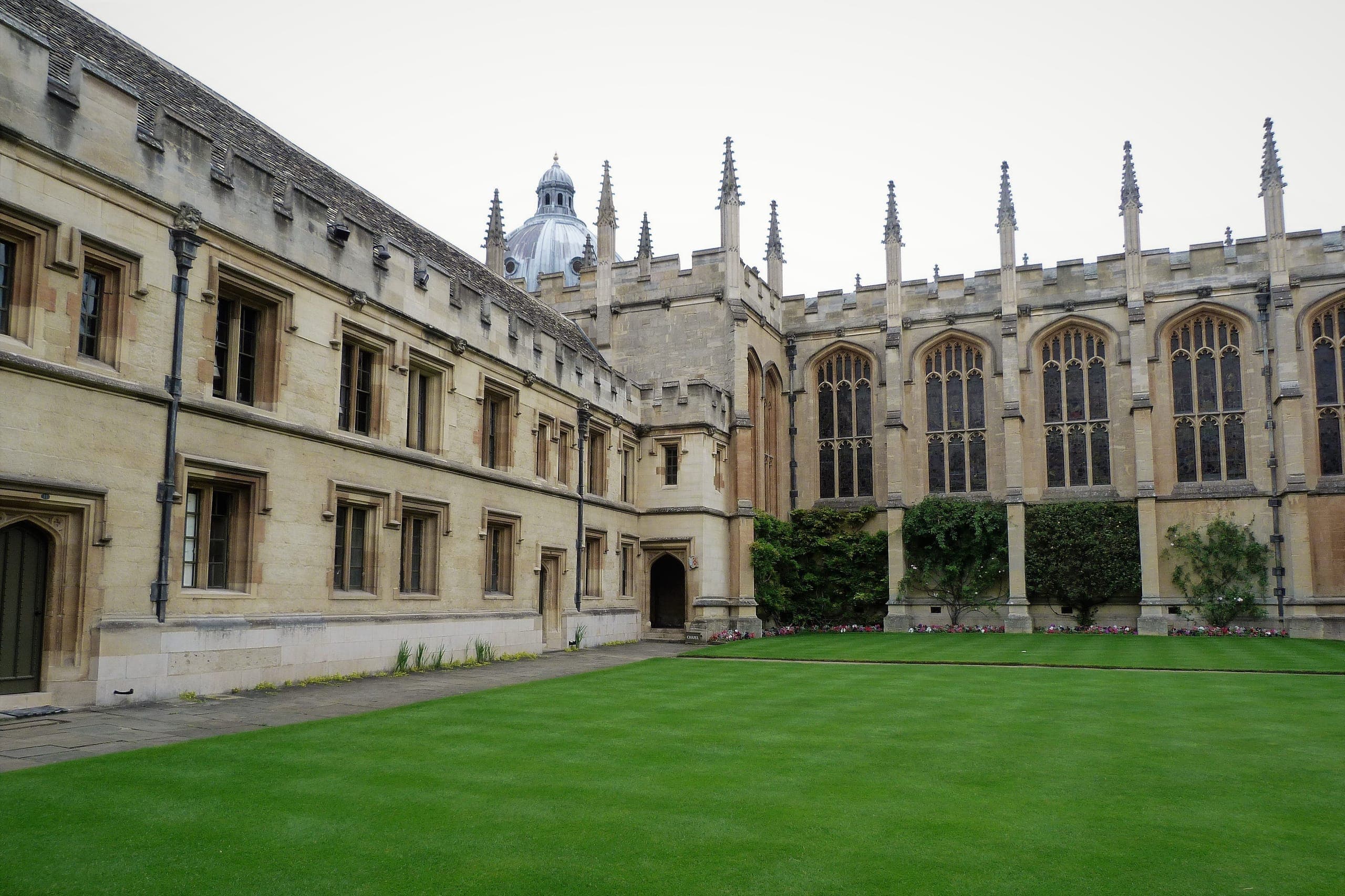
It is worth choosing a college for practical reasons: accommodation, location, subject tutors, atmosphere and accessibility. In reality, college choice should not be treated as a way to game the admissions process.
Section 13
Discover Uni occupation data is based on 15 students, a 50% response rate, for students graduating in 2022-23; the percentages are rounded and sum to 95%.
That sample size is small, so fine differences between sectors should not be over-read. Theology and Religion is better understood as a degree that builds argument, writing, interpretation, research habits and the ability to handle religious, textual and ethical material carefully, rather than training for one single profession.
Section 14
Oxford uses contextual data to understand achievements in context. This can include how your academic record sits against your school context and what opportunities were realistically available.
Extenuating circumstances should be explained by the applicant, referee or school/college contact. Make disruption clear, factual and specific, then return the application to academic evidence rather than writing the whole case around the disruption.
Watch & Learn
Student vlogs, mock interviews, lecture tasters, and admissions advice.
All videos are the property of their respective creators.
Further Reading
Super-curricular reading, websites, and tools recommended by our expert tutors.